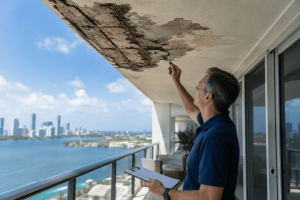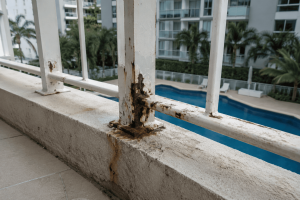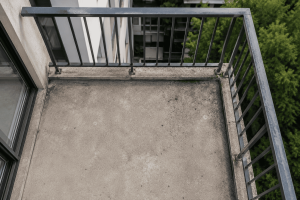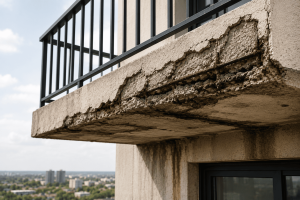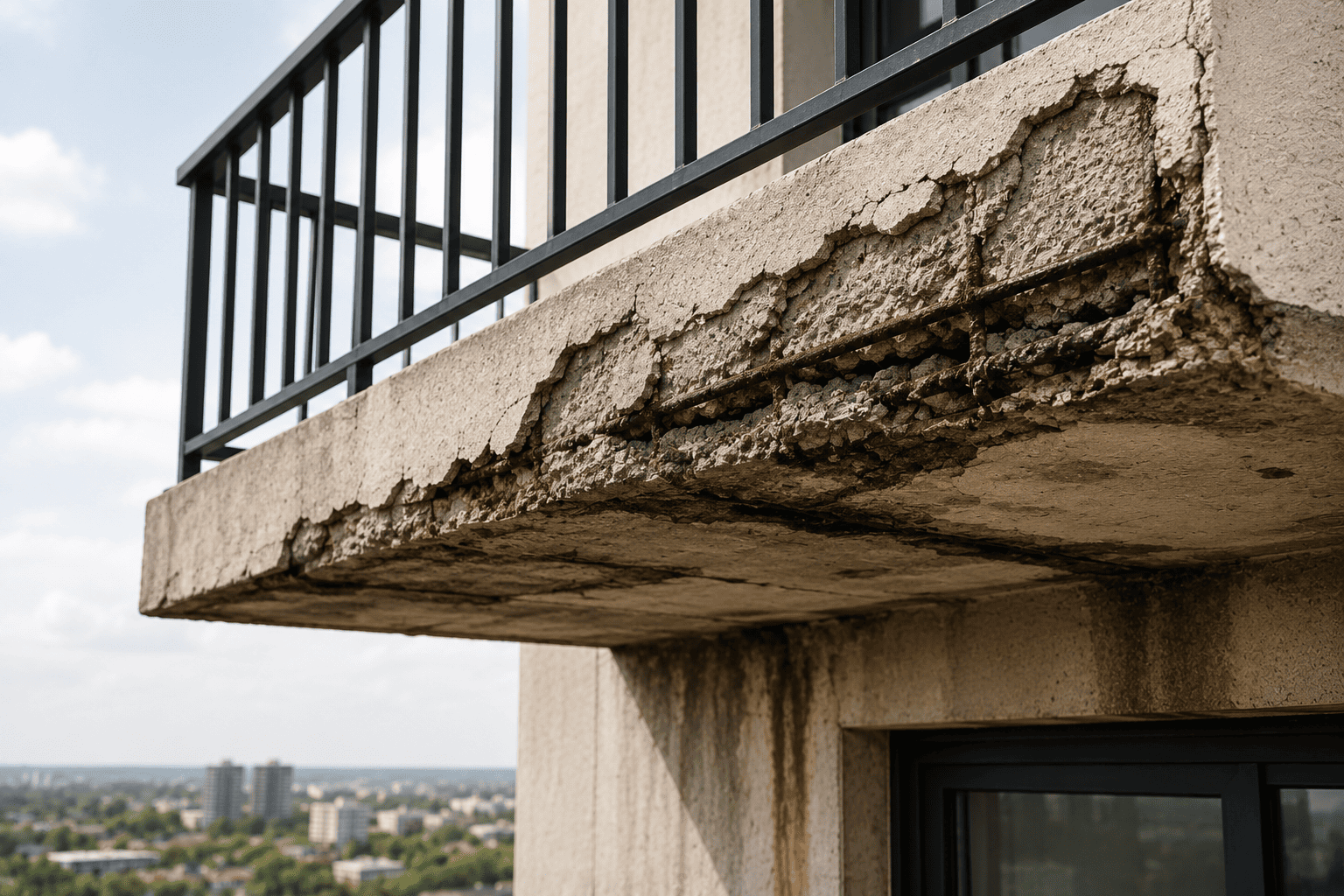
Balconies are among the most exposure-prone components of coastal Florida condominium buildings. Many are relatively thin, cantilevered, directly exposed to salt air and rain, and penetrated for railing posts or drainage. These conditions can make balconies an early location for visible deterioration and an important area for evaluation during a milestone inspection.
If your building is preparing for or has just completed a Milestone Inspection, here’s what typically shows up on the balcony section of the report, and what it means for your restoration budget.
Why balconies fail before other structural elements
Many older balcony slabs have inadequate, inconsistent, or deteriorated concrete cover over the reinforcing steel. Penetrations such as railing post sleeves, shutter anchors, and drain scuppers can also provide entry points for moisture and chlorides when they are improperly detailed or no longer watertight. Once sufficient chlorides reach the rebar, the passive protective layer around the steel can break down and corrosion can begin, often before damage is visible at the surface.
The most common issues inspectors document
1. Delamination. This is a separation within the concrete, often associated with corrosion of embedded reinforcement, that may not yet have produced visible cracking or spalling. Depending on surface conditions and accessibility, inspectors may use hammer sounding or chain-drag sounding on suitable horizontal surfaces: sound concrete generally produces a clear ring, while delaminated concrete produces a hollow or dull response. Sounding has limitations and should be performed and interpreted by qualified personnel. Delamination can be more extensive than the damage visible at the surface and may become a significant repair item.
2. Spalling. As corrosion products accumulate, they can crack and dislodge the concrete cover, sometimes exposing the reinforcing bar. This is the visible “chunk of concrete missing” condition many owners recognize. By the time spalling is visible, surrounding deterioration or delamination may extend beyond the visibly damaged area.
3. Exposed or corroded reinforcing steel. Once reinforcing steel is exposed, continued access to oxygen, moisture, and chlorides can accelerate corrosion. Engineers evaluate severity based on factors that may include the location, extent of corrosion, remaining steel area, and section loss, meaning the reduction in the bar’s original cross-section.
4. Cracking, especially along slab edges and around railing post penetrations. Cracks that follow the reinforcing pattern, run parallel to a slab edge, or radiate from a post base may indicate corrosion of embedded steel. Cracking can also have other causes, so the condition should be evaluated by the licensed design professional rather than classified from appearance alone.
5. Failed or missing waterproofing at the walking surface. Coatings and membranes have a finite service life. Once they fail, water and chloride intrusion can accelerate corrosion and related deterioration. This is closely related to what we cover in Common Waterproofing Failures in Condos, Balconies, and Parking Decks, which is worth reading if your report also flagged membrane or coating failure.
6. Corroded railing anchors. Even when surrounding concrete appears sound, the anchorage connecting a railing post to the slab edge may be deteriorated or compromised. We discuss the related safety and code considerations separately in When Balcony Railings Fail: Safety Risks and Code Compliance in Florida.
From inspection finding to repair scope
A Phase One milestone inspection is a visual examination and qualitative assessment of the building’s major structural components. If the licensed architect or engineer identifies substantial structural deterioration, a Phase Two inspection is required. At the inspector’s direction, Phase Two may include destructive or nondestructive testing, concrete cores, chloride-content testing, sounding, or selective removal of finishes to assess the extent of distress before a repair program is finalized. For a broader look at how this fits into your building’s compliance timeline, see Florida Building Codes: The Importance of Structural Inspections.
Once the licensed design professional defines the repair scope, the restoration contractor executes the work in accordance with the signed and sealed repair documents. Depending on the specified details, this may include removing unsound concrete to sound material, cleaning, supplementing, replacing, or protecting corroded reinforcement, rebuilding the slab edge with a compatible repair material, and applying a waterproofing or traffic-bearing system suitable for the exposure and intended use. This is also where structural versus cosmetic classification matters most for budgeting, because the two can require very different scopes, permits, and professional sign-offs.
FAQ: Concrete Balcony Inspections
What is delamination in a concrete balcony? Delamination is a separation within the concrete, often associated with corrosion of embedded reinforcement, that may not yet have broken through to the surface. It may be identified by visual examination, sounding, or other evaluation methods selected by the licensed design professional.
Do all balconies need to be tested, or just ones that look damaged? Balconies may be evaluated even when no damage is visible because early-stage corrosion and delamination can remain concealed. The number and location of balconies evaluated, and whether testing is required, are determined by the licensed architect or engineer based on applicable requirements, accessibility, observed conditions, and professional judgment.
Can a balcony with corroded rebar be repaired, or does it need to be replaced? It depends on the extent and location of deterioration and its effect on structural capacity. The licensed design professional determines whether reinforcement can be cleaned and protected, must be supplemented or replaced, or whether more extensive slab repair or replacement is required.
H3: How long does a typical balcony restoration take per unit? There is no reliable standard duration per balcony. Access, repair quantities, finishes, curing requirements, inspections, weather, resident coordination, and unforeseen deterioration all affect the schedule. A thorough engineering assessment and preconstruction investigation can reduce, but not eliminate, surprises during the work.
A Plus Concrete Restoration does not perform Milestone Inspections or serve as the Engineer of Record. We execute concrete restoration, waterproofing, and railing work in accordance with the licensed design professional’s approved documents. To discuss an upcoming balcony restoration project in Broward or Palm Beach County, contact A Plus Concrete Restoration for a consultation and repair estimate.
This article is for general informational purposes only and does not replace an inspection, diagnosis, or repair design by a Florida-licensed architect or engineer.